- Job security. Many fear reduced contract opportunities, fewer junior roles, and the long-term replacement of specialist expertise. As one respondent put it, “Biggest concern is job losses”, while another stated, “My role will ultimately be replaced by AI.” There is a clear sense that AI could shrink the pipeline of work particularly at entry-level and weaken the value placed on human experience.
- Fear of over-reliance and deskilling. There is a worry that people are beginning to trust AI outputs without applying their own judgement. Comments such as “People generate content that looks good but hasn’t been thought through” and “It’s making me think less, which will make me stupid in the long run” highlight anxiety that critical thinking is being eroded across sectors including education, engineering, healthcare and leadership.
- Trust and accuracy. Many contractors have seen incorrect or fabricated outputs accepted as fact. “Hallucinations that go undetected” and “False information being published” were common warnings. This is viewed as particularly dangerous in regulated, safety-critical and compliance-heavy environments where mistakes carry serious consequences.
continued
Contractor Profile
Factors Influencing Contract Work
Contractors continue to express clear views on how economic, political and technological factors shape their work. they were asked to indicate whether these factors impacts were positive, negative, or neutral. In 2026 the majority (86%) of respondents believe that greater recognition of contractors as an important part of the workforce would positively affect their contract work, along with 88% who believe that changes to tax policy relating to the claiming of travel expenses would also have a positive impact.
Collaboration with other contractors remains a strong positive factor. Contractors continue to see collaboration as beneficial. Competition itself is still not viewed as a threat. In 2026, 85% see competition as neutral or positive, with a shift from neutral to positive compared with 2025. Concerns about pressure to transfer contractors to employee status persist. With over half 55% of respondents still seeing this as harmful to contract work. Views on the transition to an eco-sustainable economy became more positive with 51% agreeing in 2025 increasing to 60% agreeing it would have positive impact in 2026.
Additional Information
Trump Policies and Contract Work
Concern about the impact of the Trump presidency intensified sharply in 2026. Negative sentiment increased from 48% in 2025, when respondents were reacting to a forthcoming presidency, to 64% in 2026, when trade policies are clearer. Positive views fell from 12% to 8%. This shift suggests contractors are moving from uncertainty to concern about the economic impact of the Trump Administration’s policies.
Additional Information
AI Usage
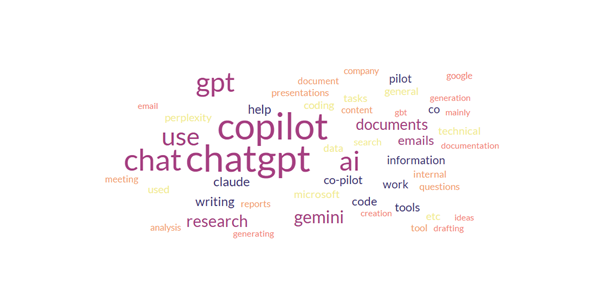
The main AI Tools and their uses identified by respondents:
- Writing support. Three tools dominate day-to-day use: ChatGPT, Microsoft CoPilot, and Google Gemini. The most common purpose is writing support. This includes drafting and rephrasing emails, improving tone, and producing first-pass documents such as reports, proposals, and executive summaries.
- Summarisation. People use CoPilot, ChatGPT, Notebook LM, and transcription tools to condense long documents, meeting recordings, and multi-file packs into actions and key points.
- Coding. GitHub CoPilot, Cursor, Claude, and ChatGPT are used for code examples, bug triage, refactoring, and faster prototyping, plus practical scripting in SQL, VBA, and PowerShell.
- Research support. Many describe AI as a “Google alternative”, with Perplexity used for deeper comparisons and multi-source scanning, and Gemini used for quick lookups.
- Verification. Users regularly state they review, correct, and cross-check outputs, especially for technical work, legal clauses, engineering specs, and healthcare information.
- Creative and media use. Canva AI, Adobe tools, Midjourney, Runway, Kling, and voice tools are used for slide visuals, marketing assets, and content production.
- Automation. N8n, Zapier, Make.com, and CoPilot Studio are used to reduce admin, create agents, and streamline repetitive workflows.
Business constraints shape choices. Several mention internal GPTs, company portals, and local LLMs for security, or note that AI is not permitted by the client. In general, usage is pragmatic. It focuses on saving time, improving clarity, and accelerating delivery. It is paired with human judgement, especially where accuracy, reputation, or compliance risk is high.
Experience with AI Adoption
Contractors were asked a number of questions on their current view and experience about AI. The data shows very strong recognition among contractors that AI capability is essential. 89% agree that technical AI training is important, and an even stronger 96% believe AI ethics and compliance training matters. This tells us contractors understand that AI is not only a tool for productivity, but also an area that carries responsibility and risk. There is clear awareness that safe and informed use is as important as technical skill.
However, this awareness is not matched by access or commitment to training. 73% say their client organisation did not provide AI training. A similar pattern appears in personal investment where 75% have not paid for AI training themselves, 93% have not attended any state funded AI training. These figures reveal a significant gap between the perceived importance of AI and the investment in upskilling.
This gap is reflected in their confidence about their current AI knowledge levels. 63% of respondents admit they are concerned that they do not know enough about AI. That is a significant figure when set against how important they believe AI knowledge to be. There is also a clear message for policy makers. 82% believe the Government should provide more funding support for AI training for the self-employed. Contractors are signalling that they are willing to learn, but want support to do so.
Additional Information

Challenges faced as AI adoption Increases
Contractors were asked an open question about the concerns or challenges they face as AI adoption increases. Contractors’ responses show caution and realism rather than resistance to AI.
Contractors are not anti-AI. They are concerned about misuse, poor oversight and lack of support. They want training, governance, realism and responsible adoption so that AI enhances work rather than undermines it.
- Skills gaps and access to training. Contractors want to use AI well but feel they lack time, exposure and quality education. “Risk of becoming outdated” and “Being left behind because of lack of exposure” were frequently expressed.
- Data privacy and confidentiality. These are major barriers to adoption in client-sensitive sectors. “I cannot use a public LLM” and “Data security is a huge issue” reflect the practical constraints many face, particularly in healthcare, finance and GDPR-regulated environments.
- Weak governance and rushed adoption. Many believe leaders overestimate AI’s capabilities and underestimate the need for human oversight. “We are in serious need of directives” and “People want AI because it’s a buzzword” show frustration with poor strategy and leadership misunderstanding AI’s limits. Contractors see AI as a tool, not a solution.
- Concerns around creativity, authenticity, environmental cost and loss of human connection. “Soulless output passed off as work” captures the worry that originality and human value may be diluted.
Impact of Increased use of AI
“In your opinion what impact if any, would the increased use of AI have on the performance of the work of Self-Employed Professionals.”
Additional Information
Benefits of Hiring Contractors for Client Companies
Contractors identify channels through which they add value to client organisations. They feel the most frequent means is by helping firms move faster and stay agile (85%), followed by the ability to address headcount issues (73%) and overcome hiring freezes (70%). A significant majority also believe they contribute to risk management and reduction (69%), cost saving (65%), and process innovation (65%). Contractors also recognise their ability to assist with knowledge transfer, with 62% say they help to upskill employees and 55% stating that they assist with product innovation.
Additional Information

Other Benefits From Engaging Contractors
When asked about ‘other’ benefits clients get from engaging contractors, contractors describe their value to client organisations in four distinct categories, flexibility, specialist expertise, speed, and capability uplift.
- Flexible resourcing. Helping firms “handle peaks and troughs in capacity need” with the “flexibility to reduce headcount quickly when required.” This is viewed as a way to respond to changing workloads without the delay or expense of permanent hiring.
- Access to scarce skills. Contractors believe they enable clients to “avail of expertise they don’t have,” “fill skills gaps their team would take time to learn,” and bring “rare expertise” with the ability to “hit the ground running.” Many frame this as senior, ready-made capability that would be costly or slow to build internally.
- Speed and delivery focused. They say they are brought in to “meet project timelines,” ensure work “remains on track re deadlines,” and provide “speed of delivery” through a clear, outcome-driven role.
- Capability uplift. They describe offering “strong mentoring for younger teams,” an “independent view,” improved governance and risk management, and in some sectors, simply enabling services to operate: “they can’t open without a pharmacist.”
Contractors see themselves as a flexible solution to workforce challenges, enabling agility, stability, and operational improvement within client companies.
How Are Contractors Treated Compared to Employees
Contractors were asked how they believe self-employed people are treated compared to employees by Revenue, Government, client organisations, and employees on-site. 2026 results show a clear divide with respondents most negative when it comes to how they are treated by the State, their views are more positive, when it comes to their treatment by client organisations and employees.
In 2026, half of contractors 50%, believe the self-employed are treated worse than employees by the Revenue Commissioners, an increase from 43% in 2025. Only 7% believe treatment by Revenue is better, down from 8% last year. Views on how Government policy treats contractors have also worsened. In 2026, 57% feel the self-employed are treated worse under Government policies, up from 51% in 2025. Perceptions of equal treatment declined, suggesting growing frustrations. In contrast, treatment by client organisations remain positive with 60% of contractors believe organisations treat the self-employed the same or better than employees, down slightly from 65% in 2025. This year 65% of contractors feel they are treated the same or better by employees on site, compared with 70% in 2025. The gap between the treatment contractors experience from Revenue and Government and the treatment they receive from organisations and colleagues continues to widen.
Additional Information
Looking To The Future
82% of independent contractors expect the availability of contract work over the next 12 months to stay the same or increase, 96% expect their daily rate to increase or stay the same and 92% of respondents expect their working days for the next 12 months to remain the same or increase. Contractors are expressing caution in their expectation about the performance of the Irish economy in 2026. The percentage of contractors who expect the Irish economy to perform better than it performed in 2025 is 37% while 26% expect the performance of the Irish economy to be worse than in 2025. The longer-term outlook for the contracting sector is more positive with 83% of respondents expecting it to remain the same or increase in the next 3 to 5 years.
Additional Information

Other Financial Goals mentioned for the next 5 years
- Retirement planning and pension protection – Many contractors are either approaching retirement or actively managing the transition. There is a focus on timing, control, and avoiding premature pension depletion. Contracting is being used as a bridge into retirement rather than a long-term growth strategy.
- Family and children-related financial responsibilities – Family support is a dominant driver of financial goals. Education costs and intergenerational support weigh heavily. Financial planning is about responsibility rather than personal wealth.
- Housing, mortgages, and home improvement – The focus is less on first-time buying and more on managing existing housing commitments. Rising costs are reshaping expectations.
- Covering living costs and financial survival – For this group, financial planning is short-term and reactive. Rising living costs are crowding out longer-term goals. This highlights uneven financial resilience within the contractor population.
- Quality of life, enjoyment, and time autonomy – Many contractors prioritise lifestyle over accumulation. Once core needs are met, motivation changes. Financial success is defined by autonomy and enjoyment rather than growth.
- Business building and self-employment growth – A small number of responses highlight entrepreneurial goals. Income stability matters, but growth and independence remain key.
- Maintaining activity, purpose, and flexibility – For many, financial goals are secondary to purpose. Contracting supports mental engagement and flexibility rather than income maximisation.
Contractors' Financial Goals in Next 5 Years
The 2026 dataset shows a clear re-prioritisation of financial goals compared with 2025. Retirement planning dominates. Saving for retirement increased significantly from 37% in 2025 to 58% in 2026. The focus is now on long-term planning and reflects an ageing contractor base and higher concern about future income security. Asset accumulation also accelerated. Building an investment fund increased from 14% to 30%. Reducing debt increased from 12% to 21%.
Additional Information
Retirement Funding
The contractor population is largely proactive and self-directed in retirement planning, but others are experiencing uncertainty and concern about long-term financial security. The 2026 data shows that retirement funding among contractors is primarily achieved by private pension provision, with 73% stating they have a private pension. The State pension will fund retirement for 34% of respondents. 12% expect to fund their retirement with income from a property portfolio and 7% are planning to downsize or release equity from their home.
However, nearly one in five contractors, 18%, report concern that they will not have enough for retirement. A further 9% have not yet thought about how they will fund retirement, suggesting delayed engagement among a minority.
Additional Information
Contractors Greatest Concerns About Independent Working
Contractors were asked about the concerns listed in the following chart, they were also asked an open question to expand on the concerns and challenges they have. In 2026, contractors describe a model of work that can be financially and professionally rewarding, but fragile at its transition points. While many accept uncertainty as part of independent work, the data shows that the moments between contracts are where concern is most acute.
- Continuity of work dominates the narrative, not because demand is absent, but because income can stop abruptly with limited notice, creating pressure around cash flow, tax planning, and personal wellbeing.
- These transition periods expose the risk and uncertainty of contracting work, which contractors feel is unfair as they have limited access to supports despite paying comparable levels of tax.
- Longer-term planning is also disrupted at these points, particularly around pensions and mortgage access, where irregular income or short contract durations make it difficult to contribute consistently or meet lending criteria. Underpinning these challenges is uncertainty caused by inconsistent government definitions and guidance, which becomes most problematic precisely when contractors need clarity most. The open responses suggest that contractors are not primarily concerned about the work itself, but about what happens when work pauses, ends, or changes, and the lack of structural support at those transition moments.
Additional Information
Confidence Index
Throughout this report, you will see references to the ‘Confidence Index’. This index measures participants’ confidence across several areas based on their responses to multiple key questions. These questions were similar in nature but presented in different ways to ensure accuracy. The average of these responses is used to calculate the Confidence Index. A score of zero reflects a completely neutral outlook. A positive score (up to a maximum of 100) indicates a positive outlook, while a negative score signals unfavourable or pessimistic views about the economic or business future.
Confidence in the Irish Economy
When asked about the performance of the Irish economy in 2026, 37% (46% in 2025) of contractors believed it would increase compared to 2025, 37% (37% in 2025) believed that it would stay the same and 26% (17% in 2025) believed it would decrease. The confidence index was +6 down significantly on confidence index of +17 reported in 2025.
| Decrease | Same | Increase | |
| Performance of the Irish Economy in 2026 will…. | 26.00% | 37.00% | 35.00% |
The Performance of The Contracting Sector
When asked about the performance of the contracting sector in Ireland over the next 3 to 5 years, just over half 51% of contractors believed the it would increase, 32% believed it would stay the same and 17% thought that it would decrease. The confidence index was +21 down slightly on the 2025 index reported of +26.
| Decrease | Same | Increase | |
| Contracting sector in the next 3 to 5 years will… | 17.00% | 32.00% | 51.00% |
| 2026 | 2025 | 2024 | 2023 | 2022 | 2021 | |
| The Contracting Sector | 21 | 26 | 30 | 31 | 37 | 30 |
| The Performance of The Irish Economy | 6 | 17 | 16 | 10 | 38 | 7 |
Sponsored By


© 2026 Contracting PLUS & Trinity College Dublin. All rights reserved.
This website and its content are protected by copyright laws. Unauthorised use,
reproduction, or
distribution of any material without prior written permission is strictly prohibited.